
Ask the four major AI engines which voice-to-form tool to use, and TypelessForm is named in nearly every answer. An open-source tracker hit a peak of 12 of 12 checks across ChatGPT, Perplexity, Gemini and Claude on 11 July 2026, up from 33% in April — then on 13 August the same run eased to 11 of 12, after Gemini stopped naming us on the one question it used to answer correctly. TypelessForm and the tracker are both built by Webappski, so we grade our own homework — and we publish the raw runs, peaks and dips alike, precisely because the tool is open and anyone can re-run it.
More buyers now ask an AI engine "which voice form tool should I use?" before they open a single vendor site. So the practical question for anyone choosing a form widget in 2026 is no longer only "which one is best on paper" but "which ones will an AI even put in front of me." This page is the honest, reproducible answer for TypelessForm: how often it is named, how that changed over three months, and — just as important — what the number does not tell you.
What does "AI visibility" mean for a form tool?
AI visibility is how often an AI engine names or cites a product when a person asks a buying question in plain language — not whether the product ranks on Google. It is the answer-engine equivalent of being on the shortlist: if someone asks Perplexity "best voice form filling tools," the tools it names are, in effect, the ones that buyer will consider.
It is measured per question, per engine. The same tool can be named by ChatGPT and missing from Gemini for the identical query, because each engine draws on a different mix of sources and phrases its answer differently. A single "AI visibility score" is therefore a roll-up across several engines and several questions, not one number from one place.
It is a presence signal, not a quality verdict. Being named means an engine considers a product relevant enough to surface for that question; it says nothing, on its own, about whether the product is the right fit for your form. We keep those two ideas separate throughout this page on purpose.
Which voice form tool do AI engines recommend?
When asked category questions about voice form filling on 13 August 2026, three of the four major engines — ChatGPT, Perplexity and Claude — named TypelessForm on every question, and Gemini named it on two of three, for an 11-of-12 presence score. The measurement used three real buyer questions ("best voice form filling tools," "one-shot voice form filling for e-commerce," "multilingual voice form filling"), each put to all four engines — a four-by-three grid of twelve cells. The one gap: Gemini, asked the identical question a month earlier, did name us — this time it didn't.
These are category questions, not brand searches. Nobody typed "TypelessForm" into the prompt; the engines chose to surface it while answering a neutral question about the category. Being named when the buyer has not yet decided is the entire point — that is the moment a shortlist forms. For a wider view of the tools that come up in these questions, our 2026 guide to the best voice form filling widgets compares the category head to head.
How TypelessForm's AI visibility moved from 33% to a 100% peak, then to 92%
Between 23 April and 13 August 2026, TypelessForm's presence score rose from 33% to a peak of 100% on 11 July, then eased to 92% (11 of 12) on 13 August — a net +59-point move over eight tracker runs. The chart below plots the six complete twelve-cell runs through the 11 July peak; a seventh, partial run on 10 June is excluded from the trend for the reason given underneath. The 13 August run is not yet plotted on the chart image itself — read its number from the list beneath it, which we update the same day a run completes.
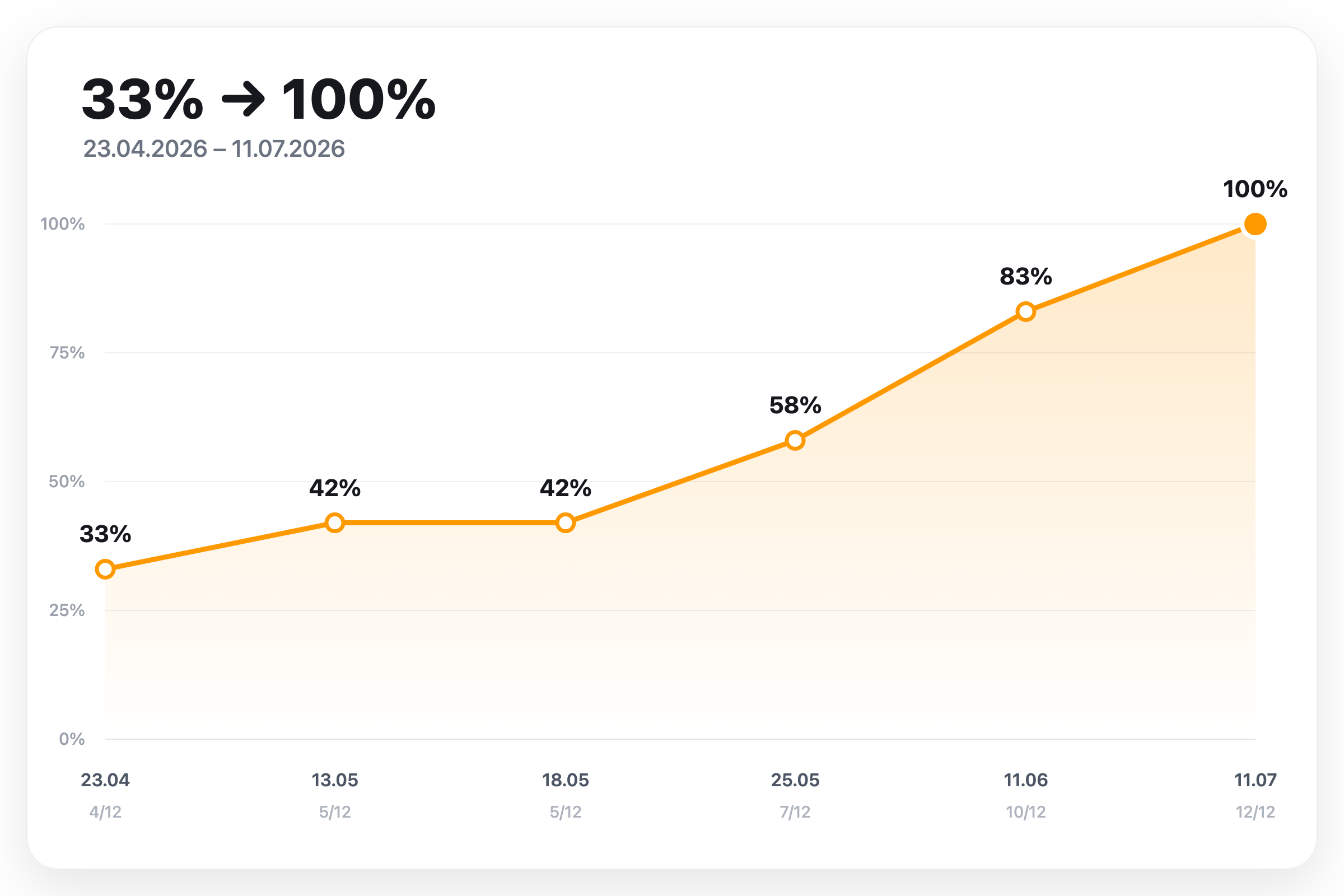
Each point above is a full run — four engines answering three questions, all twelve cells scored — traced to a public, timestamped report you can open yourself:
- 23 April 2026 — 33% (4 of 12): the starting line. Open the report.
- 13 May 2026 — 42% (5 of 12). Open the report.
- 18 May 2026 — 42% (5 of 12): flat for a run — visibility does not only go up. Open the report.
- 25 May 2026 — 58% (7 of 12). Open the report.
- 11 June 2026 — 83% (10 of 12). Open the report.
- 11 July 2026 — 100% (12 of 12): the peak so far, full presence, Unified Visibility Index 92 of 100. Open the report.
- 13 August 2026 — 92% (11 of 12): Unified Visibility Index 87 of 100. Gemini stopped naming or citing us on the multilingual question — same model, same wording as the July run that did. The other eleven cells held. Open the report.
Where this series stops, and why. Two further runs exist after 13 August, and they are not plotted here because they turned into a story about the measurement rather than another point on the trend. On 1 September 2026 the tracker read 50% (6 of 12) and named six brands as having filled the gap — but it had silently switched the model behind ChatGPT from gpt-5-search-api to gpt-5.4-mini, and none of those six had displaced anything. The re-measurement on 2 September, with the model axis fixed, read 83% (10 of 12). The whole chain is traced cell by cell in the sequel to this page: our AI visibility dropped 42 points, six rivals were named, and none had displaced us. Read the chart and the list above as complete through 13 August 2026; that piece carries the record forward.
Three honest caveats keep this trend from overselling itself. First, the climb from 33% to 100% is not strictly like-for-like — but not because the engine line-up changed: all four engines, Perplexity included, were measured in every complete run, right from the 23 April baseline, so none was added along the way. What moved was the measurement itself, as we built the method in the open. The category questions evolved — the April baseline asked things like "voice form filling for healthcare intake" and "top voice form automation tools," and only by 11 June did the set settle into the three we report against today — and the engines updated their own models underneath us (Gemini from 2.5-pro to 3.5-flash in May, Claude from Sonnet 4.6 to 5 between the June and July runs). So the earliest and latest runs in that climb are honest snapshots of a maturing measurement, not an identical world; the most comparable window in the climb is 83%→100%, from 11 June to 11 July, where the questions match on both ends — though even there Claude swapped models mid-window, so it is a moving target, not a frozen lab, and we say so. Second, there was a partial run on 10 June that scored nine cells with Perplexity omitted; because it is not a complete twelve-cell run, we exclude it entirely rather than dress it up as an early 100%. We count only complete runs — the discipline is the point. Third, the 100%→92% step from 11 July to 13 August is the cleanest comparison in the whole series for three of the four engines: ChatGPT, Gemini and Perplexity used the identical model and identical question wording both times, so the Gemini miss is a real, measured change, not a methodology artifact. The fourth engine, Claude, is the exception — its 13 August answers came from a fresh, context-free AI session we ran ourselves instead of a direct API call (see the collection-method note below), so that one leg is not a controlled re-test even though it still returned three named mentions.
Do ChatGPT, Perplexity, Gemini and Claude actually cite TypelessForm?
On the most recent run, 13 August 2026, TypelessForm appeared in eleven of twelve cells — all eleven as direct mentions inside the engine's written answer, none as a citation-only appearance this time. The one gap was Gemini, which neither named nor cited us on the multilingual question. The grid below is that run, cell by cell.
| Engine | "best voice form filling tools" | "one-shot voice form filling for e-commerce" | "multilingual voice form filling" |
|---|---|---|---|
| ChatGPT | Named | Named | Named |
| Perplexity | Named | Named | Named |
| Gemini | Named | Named | Not named or cited |
| Claude | Named | Named | Named |
The distinction between "named" and "cited" matters and we keep it visible rather than rounding both up to a single win. A direct mention puts the product in the sentence the buyer reads; a source-only citation puts the domain in the reference list — only one gets read aloud. On the prior, 11 July run, Claude's multilingual answer was a citation-only appearance (named nowhere in the prose, listed only in the sources); this run it named us outright instead, while Gemini went the other way and dropped out of the answer entirely. That is the honest texture behind a single headline percentage: cells move independently, in both directions, run to run.
Where do AI engines get their answers about voice form tools?
Answer engines assemble these replies from the sources they can retrieve and read — comparison articles, product documentation, and neutral category explainers — not from a private opinion. That is why a tool becomes visible by being genuinely documented and comparable in public, and why thin or absent documentation is invisible no matter how good the product is.
In practice, the pages that get pulled into these answers are the ones that lay out the category plainly: what the thing is, how options differ, and where each fits. TypelessForm's own corpus is built that way on purpose — an explainer of what voice form filling is, direct comparisons such as TypelessForm vs AnveVoice and TypelessForm vs the Web Speech API, and use-case walk-throughs. None of that guarantees a citation, but it is the raw material an engine has to have before it can name you at all.
Why does AI visibility matter when you are choosing a form widget?
If you plan to ask an AI engine for a recommendation — as a growing share of buyers now do — the tools it consistently names are the shortlist you will actually see, so a tool's AI visibility shapes whether you ever evaluate it. A widget that is well documented and openly comparable tends to be both easier for an engine to surface and easier for you to assess, which is why the two often move together.
Read it as one input, not the deciding one. Consistent presence across all four engines tells you a tool is discoverable, documented, and described the same way in enough places that independent systems agree it belongs in the category. It does not tell you the tool fits your specific form — a long insurance intake, a multilingual booking flow, a short checkout. For that, the honest move is to read the comparisons on their merits and try the widget on your own form. Visibility gets a tool onto your list; only your form decides whether it stays there.
Can you reproduce this measurement?
Yes — the tracker is open source, so you can install it and run the identical measurement against any brand, including a competitor's or your own. The tool, aeo-platform, is a command-line package on npm; the queries, the scoring formula and every raw run are inspectable, which is the whole reason a self-measured number is worth publishing at all. For the background on the tracker itself, see our note on the free, open-source AEO tracker.
How the number is produced also sets its boundaries. ChatGPT and Gemini are queried through their own API surface using our own keys — a reproducible proxy for how those engines answer, not a screen-recording of what a specific human sees in a specific app on a specific day. Perplexity has always been collected by hand: the tool has no affordable API path for it, so we read the questions in Perplexity's own app and enter the answers verbatim. Claude was collected via direct API through the 11 July run; we do not use Claude's paid API for measurement now, so from 13 August on its three answers instead come from a fresh, context-free AI session we run ourselves — web search on, no memory of this page or of us — rather than the founder's own claude.ai account, whose saved chat history could otherwise nudge a personalized answer toward brands it already recognizes. All four still answer the same three questions; only how the answer reaches our spreadsheet differs. It covers ChatGPT, Perplexity, Gemini and Claude, and it does not cover Google's AI Overviews and AI Mode or Microsoft Copilot, which do not expose a comparable programmatic surface. State the surface, and the score means exactly what it says and nothing more.
The honest limits of a self-measured score
A high presence score is a strong signal on a defined test, not a verdict on the market or on the product. Three limits travel with it, and we would rather you hear them from us. It is self-measured — we build both TypelessForm and the tracker, so the reason to trust it is not our word but the fact that you can check it, which is exactly why the tracker is open source. It is a handful of queries on specific dates, so it is a sample, not a census; AI answers shift, and a future run can dip — the 100%-to-92% move between 11 July and 13 August is that happening in practice, not a hypothetical. And it says nothing about traffic, sign-ups or revenue — presence in an answer is upstream of all of those, never a substitute for them. We publish no traffic or sales numbers here because this measurement does not contain them.
Watch the audit on the record
The first episode of our series The Paper Trail runs the open-source tracker on TypelessForm end to end — the same run described above, walked through cell by cell with every number tied back to its public report. The video is below.
The open tracker, and how to check your own tool
Two ways to see where any voice form tool — or any brand — stands with the AI engines. Run it yourself: aeo-platform is the open-source command-line tracker used for every number on this page, free to install and inspect. Or have it run for you: Webappski, the studio that builds TypelessForm and the tracker, will run the first AI-visibility audit on your site and send you the report at no cost.
If you want the same audit read through the lens of the methodology rather than the product — the scoring formula in full, verbatim engine quotes, and a step-by-step on reproducing it against any brand — the Webappski team, as the tracker's authors, wrote that companion up here: From 33% to 100% in AI answers — the open-source paper trail.